
Real Estate Information Archive

Blog

Displaying blog entries 1-4 of 4

If you’re trying to decide between Papillion, Gretna, and Bennington, you’re probably not just comparing cities. You’re trying to figure out where your life is going to feel right on a daily basis.

That’s usually what this decision comes down to.

Most families we talk to already know they want to be in the Omaha area. The real question becomes what their mornings look like, how far they’re driving every day, where their kids go to school, and whether the neighborhood actually feels like home. On paper, these three communities can look pretty similar. Once you spend time in them, they start to feel very different.

Papillion tends to feel the most settled right away. When you drive through it, you notice that things are already in place. The parks are established, the neighborhoods have matured, and you’re not waiting for restaurants or stores to be built. It’s the kind of place where your routine feels easy almost immediately. You can run errands, get to activities, and move through your day without thinking too much about logistics. For many families, that simplicity is a big deal. It removes friction from everyday life, and people don’t always realize they value it until they experience it.

Gretna, on the other hand, feels like it’s in motion. There’s a sense that things are actively being built around you. You’ll see new subdivisions going up, new schools expanding, and more development coming in every year. For some buyers, that energy is exciting. They like the idea of moving into a newer home in a newer neighborhood and being part of a growing area. At the same time, that growth can come with trade-offs. You might deal with construction nearby, or find that certain amenities are still a short drive away while the area catches up. The people who choose Gretna usually understand that and are comfortable with it because they’re thinking about where the area will be in a few years, not just where it is today.

Bennington has a completely different feel from both. When you spend time there, it’s noticeably quieter. There’s more space, less traffic, and a stronger sense that you’re in a distinct community rather than just another suburb. For families who want a slower pace, that can be really appealing. It feels more personal, more connected, and a bit removed from the busier parts of Omaha. That doesn’t mean you’re isolated, but you are making a conscious trade-off. You’ll likely drive a little farther for certain things, and your commute might be longer depending on where you work. The families who choose Bennington are usually okay with that because what they gain in space and lifestyle matters more to them than convenience.

A lot of buyers start this process thinking the decision will come down to price or square footage. In reality, it usually comes down to how each area fits into their routine. One family we worked with originally focused on Gretna because they wanted a newer home. After spending a weekend driving through Papillion and seeing how close everything was, they changed direction completely. It wasn’t about the house anymore. It was about how easy life felt there. On the flip side, we’ve had clients choose Gretna specifically because they wanted something brand new and were excited about being part of a growing community. And then there are the families who walk into Bennington and immediately say, “This is more our pace.” That feeling tends to be pretty clear when it happens.

There isn’t one right answer here, and that’s why this question comes up so often. Each of these areas works really well for the right person. The key is understanding what matters most to you before you decide. If convenience and established amenities make your life easier, Papillion tends to stand out. If you’re drawn to new construction and future growth, Gretna usually makes more sense. If you want space and a quieter, more community-driven environment, Bennington is often the better fit.

The Heim-Berg Team is a real estate team in Omaha, Nebraska, helping buyers compare communities like Papillion, Gretna, and Bennington based on how they actually live day-to-day. If you’re trying to sort through these options, we can walk you through commute patterns, neighborhood differences, home availability, and what each area really feels like beyond just listings online.

Heim-Berg Team
Ambassador Real Estate, Berkshire Hathaway HomeServices
402-677-9024

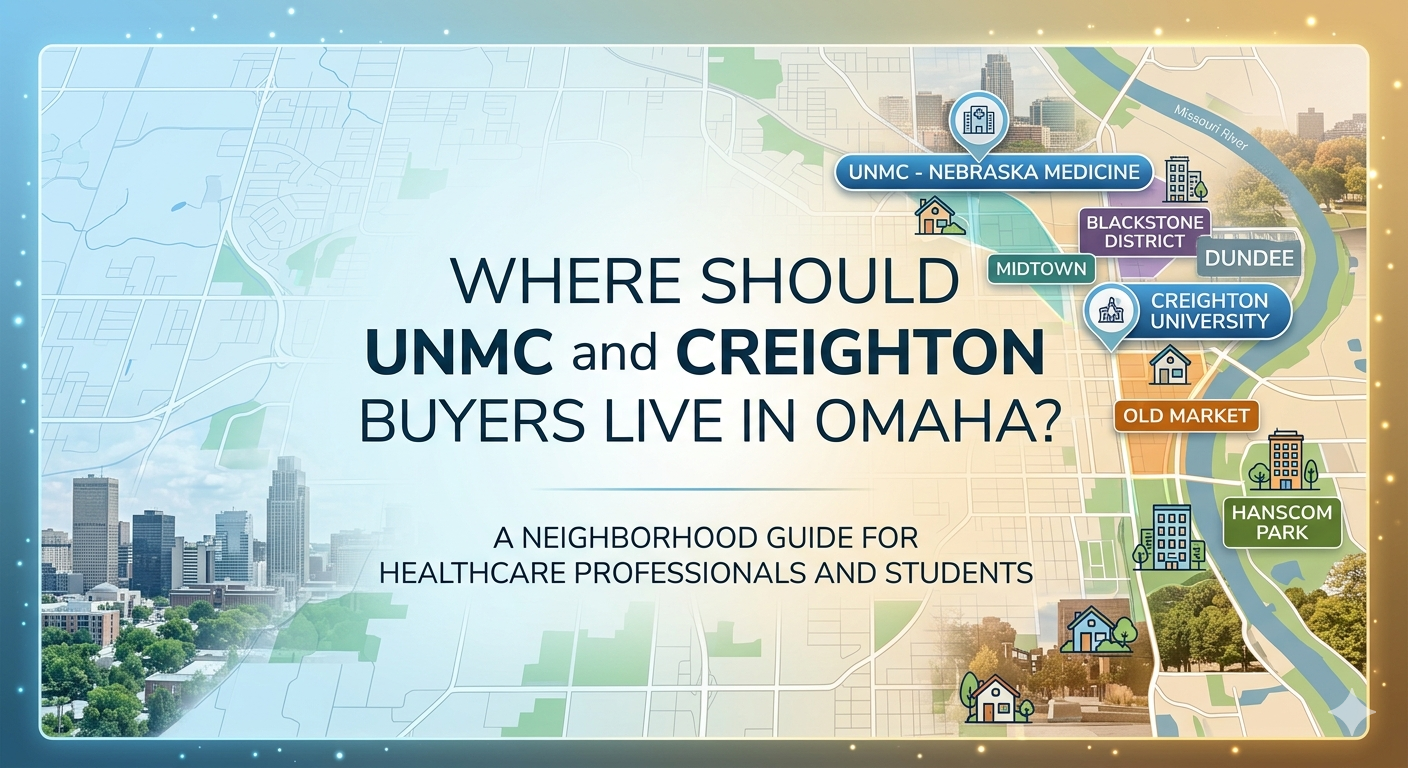
Where Should UNMC and Creighton Buyers Live in Omaha?

by Nancy Heim-berg

If you’re moving to Omaha for the University of Nebraska Medical Center or Creighton University, you’re probably not just thinking about square footage or how many bedrooms you need. What most people really want to know is this:

Where should I live so my day-to-day life actually feels manageable?

That question matters more than people expect. Omaha is a very livable city, but your experience can feel completely different depending on where you land. A ten-minute drive versus a twenty-five-minute drive doesn’t sound like much at first… until you’re doing it every day after a long shift or an early morning.

The Heim-Berg Team with Berkshire Hathaway HomeServices Ambassador Real Estate sees this all the time. Buyers come in focused on the house, then quickly realize lifestyle and location are what really shape their experience.

Start With Your Daily Routine, Not Just the House

If you’re working at UNMC or Creighton, your schedule probably isn’t predictable. Early mornings, long days, maybe nights or weekends. That changes how you should think about where you live.

A lot of buyers initially assume they’ll just “drive in.” And yes, you can live in the suburbs and commute. But what feels fine on paper can start to wear on you when you’re tired or short on time.

That’s why many buyers prioritize proximity over perfection.

You can always change a kitchen later. You can’t change your commute.

Dundee: Character, Convenience, and a True Neighborhood Feel

Dundee is one of those areas that people either immediately connect with or don’t. But for the right buyer, it just works.

When you drive through Dundee, you notice it right away. Mature trees, older homes with real character, front porches, people out walking. It doesn’t feel manufactured or new. It feels established.

For UNMC and Creighton buyers, the location is a big advantage. You’re close enough that getting to work is easy, even on days when traffic or timing isn’t ideal.

Buyers who choose Dundee usually care about things like:

They want a home that feels unique, not one of twenty identical builds.
They like being near local spots instead of big-box everything.
They’re okay with an older home if it means a better location.

One of our buyers recently moved here from out of state for a residency program. At first, they were looking at newer construction farther west. But once they spent a weekend in Dundee, walked around, grabbed coffee, and saw how close everything was, their priorities shifted fast.

They ended up choosing a smaller, older home. No regrets. The shorter drive and the feel of the neighborhood made the difference.

Aksarben: Energy, Walkability, and Low-Maintenance Living

If Dundee feels classic, Aksarben feels active.

The Aksarben area has grown into one of the most walkable, connected parts of Omaha. Restaurants, coffee shops, fitness studios, green space, events. It’s all right there.

For buyers tied to UNMC or Creighton, this can be a really practical option, especially if your schedule is demanding and you don’t want to spend your free time driving across the city.

Aksarben tends to attract buyers who:

Want a more modern environment
Prefer lower-maintenance living like townhomes or newer builds
Like being able to walk to dinner or unwind without planning it

We worked with a Creighton-affiliated buyer who chose Aksarben specifically because of that flexibility. After long days, they didn’t want to get back in the car just to grab food or relax. Being able to step outside and have options nearby changed how they experienced their time off.

It’s not just about convenience. It’s about how your life feels between work hours.

Midtown: The Middle Ground That Makes Life Easier

Midtown is often where buyers land when they want balance.

It’s close to both UNMC and Creighton. It gives you access to multiple parts of Omaha without feeling stuck in one corner of the city. And it offers a mix of housing styles, from historic homes to condos and apartments.

For a lot of buyers, Midtown ends up being the “this just makes sense” option.

You’re not committing to one specific lifestyle. You’re giving yourself flexibility.

That matters more than people think, especially if you’re new to Omaha. You don’t always know right away which parts of the city you’ll use most. Midtown gives you a central base while you figure that out.

One buyer we helped was relocating for a research role at UNMC. They didn’t know Omaha well and didn’t want to overcommit to one neighborhood too quickly. Midtown gave them access, shorter commute times, and the ability to explore before making a longer-term decision.

What About the Suburbs?

This is where the conversation usually shifts.

Yes, you can absolutely live in places like Papillion, Elkhorn, Gretna, or Bennington and commute into Omaha. And for some buyers, that’s the right move.

If you’re prioritizing:

Newer construction
More space
A quieter environment

Then the suburbs can make a lot of sense.

But here’s the part that often gets overlooked.

Your commute becomes part of your lifestyle.

If you’re working consistent hours and don’t mind driving, it may not bother you. Some buyers genuinely enjoy the separation between work and home.

But if your schedule is unpredictable, or if you’re already stretched thin, that extra drive time can add up quickly.

We’ve had buyers go both directions. Some start in the suburbs and later move closer in. Others try close-in living first and then decide they want more space and are okay with the trade-off.

There isn’t one right answer. It depends on how you actually live.

Matching Your Lifestyle to the Right Area

This is the part that matters most, and it’s where a lot of buyers get stuck.

You can find a house in almost any part of Omaha. That’s not the hard part.

The hard part is choosing a location that fits your day-to-day life.

Do you want charm and character, even if it means an older home?
Do you want walkability and energy right outside your door?
Do you want space and quiet, even if it means more driving?

Those are the real questions.

The Heim-Berg Team works with a lot of buyers connected to UNMC and Creighton, and the pattern is always the same. The best decisions happen when buyers focus on how they live, not just what they buy.

A Quick Reality Check Most Buyers Appreciate

It’s easy to get caught up in listings, prices, and features. That’s normal.

But after helping a lot of buyers through this exact situation, here’s what tends to matter most long-term:

How easy it is to get to work
How you spend your time outside of work
How your home fits your energy, not just your budget

The house itself matters. Of course it does.

But your location shapes your routine every single day.

Final Thoughts: There’s No “Best” Neighborhood… Only the Right One for You

People love asking, “What’s the best area near UNMC or Creighton?”

The honest answer is that it depends on you.

Dundee works for buyers who want character and proximity.
Aksarben works for buyers who want activity and walkability.
Midtown works for buyers who want flexibility and central access.
The suburbs work for buyers who want space and are okay with the commute.

All of those can be the right choice.

The key is making sure the decision fits your life, not just the listing.

The Heim-Berg Team is a real estate team in Omaha, Nebraska, helping buyers relocating for UNMC, Creighton, and other professional opportunities find the right fit based on lifestyle, commute, and long-term goals.

If you’re trying to figure out where you should live in Omaha, the best next step is a simple conversation. No pressure. Just a clear look at your options so you can make a decision that actually works for how you live.

Heim-Berg Team
Berkshire Hathaway HomeServices Ambassador Real Estate
Omaha, Nebraska
402-677-9024

A lot of Omaha sellers are quietly asking the same question right now: do I really have to renovate this older house before I sell it? And if your home is in Dundee, Benson, Midtown Omaha, or another established area in Omaha, that question becomes even more personal.

Maybe the original woodwork is stunning, but the kitchen hasn’t been touched in 30 years. Maybe the home has incredible character, but the electrical or plumbing systems are older. Maybe you know buyers love the location, but the idea of pouring $30,000–$80,000 into renovations right before you leave just doesn’t sit right. That tension is exactly where many Omaha homeowners get stuck.

The honest answer is yes, you can absolutely sell an older Omaha home as-is. Homes sell this way every single day. But the real conversation isn’t just “can you?” It’s “should you?” and more importantly, “what’s the smartest way to do it so you don’t leave money on the table?”

What “As-Is” Actually Means in Omaha

There’s a common misconception that “as-is” means doing nothing and just putting the house on the market. That’s not really how it works, especially in older Omaha neighborhoods where buyers are paying close attention.

Selling as-is simply means you’re choosing not to take on major renovations or upgrades before listing. You’re not remodeling the kitchen, you’re not gutting bathrooms, and you’re not trying to make the home look like new construction. But that doesn’t mean you skip preparation entirely.

In fact, the most successful as-is sales still involve thoughtful prep. Sellers who do well in Dundee, Benson, and Midtown understand that presentation still matters. Deep cleaning, decluttering, improving lighting, and making small repairs go a long way toward helping buyers emotionally connect with the home.

Buyers don’t expect perfection in these neighborhoods. They expect authenticity. But they also want to feel like the home has been cared for, not neglected.

Why Older Omaha Neighborhoods Are Different

One of the biggest advantages you have as a seller in these areas is that you’re not competing in the same way as newer subdivisions. Buyers looking in Dundee or Midtown aren’t usually cross-shopping brand-new builds in West Omaha. They’re looking specifically for character, location, walkability, and history.

That changes the entire conversation.

A buyer considering a 1920s home in Dundee already knows it won’t have the same layout or finishes as a 2022 build. They’re okay with that. In fact, that’s often the reason they’re shopping there in the first place. They want the charm, the mature trees, the established feel of the neighborhood.

But that doesn’t mean the condition doesn’t matter. It just means buyers evaluate condition differently. They’re asking questions like: has this home been maintained over time? Are the big systems functional? Does anything feel like a hidden problem?

That’s where your strategy matters more than the actual level of renovation.

Where Sellers Typically Overspend (And Regret It)

This is where a lot of Omaha sellers unintentionally lose money. They assume they need to fully modernize their home to compete. So they start pricing out kitchen remodels, bathroom upgrades, new flooring, and cosmetic overhauls.

The problem is, those projects don’t always return what you think they will.

In older neighborhoods, buyers often have their own vision. If you install a mid-range kitchen, the next buyer may still plan to renovate it later to match their taste. That means you paid for an upgrade that didn’t fully translate into a higher sale price.

We’ve seen sellers spend tens of thousands of dollars trying to “keep up,” only to realize later that the market would have accepted the home with much simpler improvements.

The reality is, the highest-return updates are usually the least glamorous ones. Clean homes sell better. Bright homes feel larger. Well-maintained homes create trust. Those factors influence buyer perception more than whether your countertops are quartz or laminate.

What Actually Matters to Buyers Right Now

If you’re selling an older home as-is in Omaha, buyers are usually focusing on a few key things, whether they say it out loud or not.

They’re looking at the overall condition first. Does the home feel solid? Does anything seem neglected? Even small issues can raise bigger concerns for a buyer if the home feels poorly maintained.

They’re paying attention to major systems. Roof, HVAC, electrical, and plumbing matter more than cosmetic finishes. A dated kitchen is easier to live with than an unknown furnace.

They’re evaluating layout and livability. Some older homes have quirks that buyers love, while others feel harder to work with. This doesn’t mean you need to change the layout, but it does mean you need to understand how buyers will perceive it.

And most importantly, they’re comparing value. Buyers are always mentally stacking your home against others in the same price range. If a nearby home is fully renovated and yours is not, that difference has to show up in the price.

A Real-World Example From Midtown Omaha

One Midtown seller we worked with owned a beautiful older home with incredible original woodwork and a great location, but the kitchen and bathrooms were clearly outdated. They initially felt pressure to renovate before listing because they had seen nearby homes selling for higher prices.

After looking closely at the comps, we realized something important. The fully renovated homes that sold at the top of the market had significantly larger budgets and complete updates throughout. Matching that level would have required a much bigger investment than they were comfortable making.

Instead of over-renovating, we focused on making the home feel clean, well-cared-for, and honest. We addressed a few small repairs, improved lighting, and ensured everything looked move-in ready, even if it wasn’t updated.

We priced the home strategically based on its condition, not based on the highest sale in the neighborhood. The result was strong interest from buyers who specifically wanted a Midtown home with character and were excited to update it over time.

That’s the difference between guessing and having a clear strategy.

The Pricing Conversation (Where Most As-Is Sales Go Wrong)

If there’s one area where as-is sales fall apart, it’s pricing.

Some sellers hear “you can sell as-is” and assume it means they can price their home as if it were fully renovated. That’s where frustration starts. The home sits. Showings slow down. Price reductions follow. And suddenly, the listing feels stale.

Buyers today are informed. They’ve seen the renovated homes. They’ve walked through them. They understand the difference in condition, and they price that difference in immediately.

That doesn’t mean you have to aggressively discount your home. It just means the pricing needs to reflect reality. When it does, you often create more interest, more competition, and ultimately a stronger outcome.

In many cases, a well-priced as-is home can generate multiple offers, especially in desirable neighborhoods like Dundee and Benson where inventory is limited.

Should You Ever Renovate Before Selling?

There are situations where light updates make sense. If a home has obvious cosmetic issues that create a negative first impression, addressing those can help significantly. Things like worn paint, outdated fixtures, or poor lighting can make a home feel more dated than it actually is.

But full renovations are a different conversation.

Before committing to a major project, it’s important to ask a simple question: will this investment clearly increase my net profit after costs, time, and risk? In many Omaha cases, the answer is no, especially in older neighborhoods where buyers expect some level of customization.

The smarter move is often selective improvement combined with strong market positioning.

The Emotional Side of Selling an Older Home

There’s also something else that doesn’t get talked about enough. Selling an older home, especially one you’ve lived in for years, is emotional.

These homes often carry history. Memories. A sense of identity. The idea of “fixing everything” before selling can feel overwhelming, both financially and mentally.

Selling as-is can actually be a relief when it’s done the right way. It allows you to move forward without taking on a major project at the end of your time in the home. It also allows the next owner to bring their own vision to the property, which is often part of the appeal in these neighborhoods.

How the Heim-Berg Team Approaches As-Is Sales in Omaha

This is where having the right guidance matters. The Heim-Berg Team is a real estate team in Omaha, Nebraska helping sellers navigate decisions like this every day. Instead of pushing renovations or defaulting to “just list it,” the focus is on understanding your specific home, your timeline, and your financial goals.

Every home is different. Every seller is in a different situation. The goal is to help you make a decision that actually makes sense for you, not just what sounds good in theory.

Sometimes that means recommending a few targeted updates. Sometimes it means confidently going to market as-is. And sometimes it means waiting altogether if that creates a better outcome.

So, Can You Sell As-Is in Dundee, Benson, or Midtown?

Yes, you can. And in many cases, it’s the smartest move.

But the success of that decision depends on how you prepare, how you price, and how you position the home in the market. It’s not about doing nothing. It’s about doing the right things and avoiding the expensive mistakes that don’t pay off.

If you own an older home in Dundee, Benson, Midtown, or anywhere in Omaha and you’re trying to figure out your next step, a simple conversation can usually bring a lot of clarity.

The Heim-Berg Team | Omaha, NE | Ambassador Real Estate, Berkshire Hathaway HomeServices | 402-677-9024 can help you look at your home objectively, understand what buyers will actually respond to, and decide what’s worth doing before you list and what you can confidently leave alone.

If you opened your 2026 valuation notice and felt your stomach drop, you are not alone. Omaha homeowners have been actively discussing sharp valuation jumps this spring, which immediately raises the next question: Should you stay put, protest the value, or use this moment to sell while your equity position feels strong? It’s a smart question, and it deserves a real answer instead of a panicked one.

Here’s the part most homeowners miss: a higher county valuation does not automatically mean your home will sell for that exact number, and it also does not automatically mean you should rush to list. County valuations, buyer demand, neighborhood inventory, condition, layout, updates, and timing all matter separately. In other words, a valuation notice is a signal, not a sales strategy.

For sellers in places like West Omaha, Elkhorn, Millard, and Papillion, this is where emotions can get expensive. Some owners see the number and think, “Great, I should cash out now.” Others think, “If values jumped this much, I can probably price even higher.” Both reactions can backfire. Buyers are still paying attention to condition, location, and whether a home feels worth the ask. 

So when does a valuation jump actually become a reason to sell? Usually when it lines up with a life change that is already pushing you toward a move. Maybe you are tired of maintaining a larger house. Maybe property taxes feel heavier than they did a few years ago. Maybe your kids are gone and you are paying for space you barely use. Maybe you would rather redeploy your equity into a ranch, a townhome, or a lower-maintenance lifestyle. That is a real conversation. What is not a great reason to sell is pure fear without a plan.

There is also a difference between “my taxes are frustrating” and “selling is my best financial move.” If the house still fits your life, your mortgage is comfortable, and you love your neighborhood, selling just because the valuation moved may create more disruption than benefit. On the other hand, if you were already halfway out the door, the valuation notice can be the nudge that finally gets you serious about reviewing your options. That review should include the likely sale price, estimated net proceeds, replacement-housing cost, and whether you would be happier east, west, or outside the metro core.

If you’re trying to figure out whether your new valuation is a reason to stay, protest, or sell, we can help you look at the bigger picture. We’ll help you compare your county value to real neighborhood sales, talk through your timing, and figure out whether selling actually improves your situation. Heim-Berg Team | Ambassador Real Estate, Berkshire Hathaway HomeServices | 402-677-9024.

Displaying blog entries 1-4 of 4

Syndication

Categories

Archives

Share This Page

Contact Information

Photo of Heim-Berg Team Real Estate
Heim-Berg Team
Berkshire Hathaway
331 Village Pointe Plaza
Omaha NE 68118
(402) 677-9024
(402) 679-7108 | (402) 830-6123
Fax: 402-493-4805

Stacey OHara CMG financial 515-306-2360


©2015 BHH Affiliates, LLC. Real Estate Brokerage Services are offered through the network member franchisees of BHH Affiliates, LLC. Most franchisees are independently owned and operated. Berkshire Hathaway HomeServices Ambassador Real Estate and the Berkshire Hathaway HomeServices Ambassador Real Estate symbol are registered service marks of HomeServices of America, Inc®. Equal Housing Opportunity. Equal Housing Opportunity Realtor License